
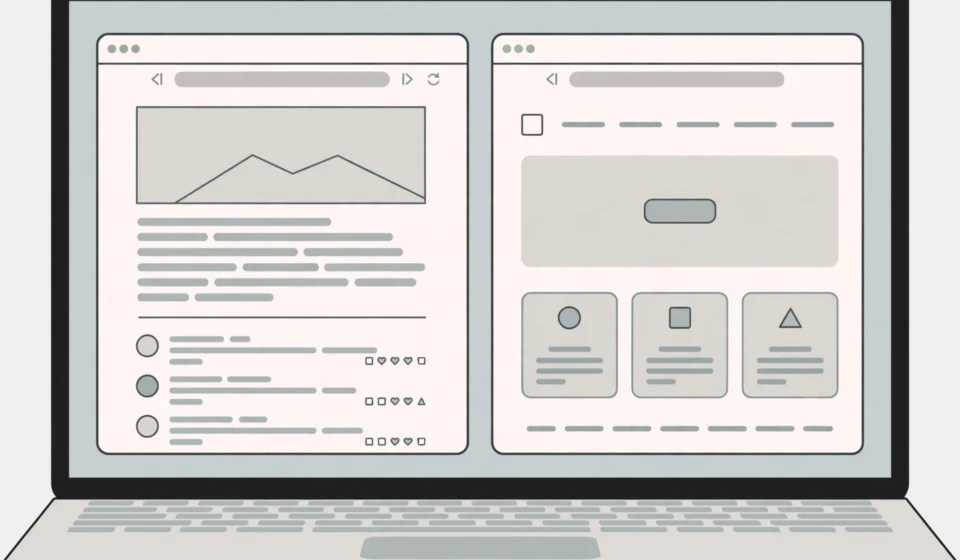

If you are planning your first online project, you have probably run into a confusing question: should you build a blog or a website? The two terms are often used interchangeably, but they describe different things — and the distinction matters. Choosing the wrong format can slow you down, while choosing the right one gives your project a head start.
The short answer is that a blog is actually a type of website. Every blog is a website, but not every website is a blog. The difference comes down to how content is organized, how often it is updated, and what the site is trying to achieve. This guide breaks down the blog vs website comparison so you can make the right choice for your goals.
What Is a Website?
A website is a collection of web pages under a single domain name. Traditional websites are built around static pages — content that stays mostly the same over time. Think of a company’s homepage, its About page, a services page, and a contact page. This content is organized in a hierarchy, linked through navigation menus, and updated only when the business or its information changes.
Websites exist to present information, generate leads, sell products, or provide a service. A restaurant’s website shows the menu and opening hours. A freelancer’s website displays a portfolio and rates. The content is timeless: an About page written today should still make sense two years from now.
What Is a Blog?
A blog is a type of website where content is published as posts in reverse chronological order — the newest article appears first. Blog posts are timely pieces of content: tutorials, opinions, news, stories, and guides. Readers can usually comment on posts, share them, and follow the blog for updates.
Key characteristics of a blog
- Regularly updated — new posts appear on a schedule, from daily to monthly.
- Reverse chronological order — the latest post sits at the top of the blog page.
- Categorized and tagged — posts are organized by topic so readers can browse related content.
- Interactive — comments, social sharing, and RSS feeds let readers engage and stay updated.
- Personal or editorial voice — blog posts usually have an author and a distinct point of view.
Blogs can stand alone as independent sites or live as a section within a larger website. Many businesses run both: a traditional website for their core pages plus a blog for articles that attract search traffic and educate customers.
Blog vs Website: The Key Differences
Content structure
Websites organize content into pages arranged in a hierarchy — Home, About, Services, Contact. Blogs organize content into posts sorted by date and grouped with categories and tags. This is the most fundamental difference in the blog vs website debate.
Update frequency
Websites are relatively static. A business might update its website a few times a year. Blogs are dynamic by design — publishing fresh content regularly is the whole point. Search engines tend to favor sites that publish new content, which is one reason blogs often attract more organic traffic.
Interactivity
Blogs are built for conversation. Comments, sharing buttons, and subscriptions invite readers to participate. Traditional websites are more one-directional: they present information and ask the visitor to take a specific action, like calling or buying.
Purpose and goals
Websites usually serve a business function — credibility, lead generation, or sales. Blogs usually serve a content function — education, entertainment, community building, or personal branding. Of course, the two overlap constantly: a blog can generate leads, and a website can include articles.
SEO behavior
Because blogs publish frequently and target specific search queries, they tend to accumulate search traffic over time. Each post is a new chance to rank. Websites rely more on a smaller number of optimized pages. For competitive keywords, an active blog is usually the stronger SEO asset.
Pros and Cons of a Blog
Advantages of starting a blog
- Steady traffic growth — every post is a new entry point from search engines and social media.
- Authority building — regular, helpful content establishes you as an expert in your field.
- Low startup cost — a blog needs little more than a domain, hosting, and your time.
- Community — comments and subscribers create a loyal audience around your work.
- Monetization options — ads, affiliates, sponsorships, and digital products all work well on blogs.
Disadvantages of a blog
- Time commitment — a blog that is not updated regularly loses momentum and readers.
- Slower initial results — it can take months of consistent publishing before traffic builds.
- Content pressure — coming up with fresh topics week after week is genuinely hard work.
Pros and Cons of a Website
Advantages of building a website
- Professional presence — a polished website builds instant credibility for a business or freelancer.
- Clear conversion path — every page can guide visitors toward a booking, purchase, or inquiry.
- Lower maintenance — once built, a website needs only occasional updates.
- Full control of messaging — static pages let you craft exactly the impression you want.
Disadvantages of a website
- Limited traffic sources — without fresh content, a website depends on ads, referrals, or brand searches.
- Harder to rank — a handful of pages gives search engines fewer reasons to send you visitors.
- Can feel impersonal — static pages do not build relationships the way regular articles do.

Blog vs Website: Which Should You Choose?
Choose a blog if…
- You want to share knowledge, stories, or opinions on an ongoing basis.
- Your goal is to build an audience or personal brand.
- You plan to monetize through content — ads, affiliates, or digital products.
- You enjoy writing and can commit to a publishing schedule.
Choose a website if…
- You need an online presence for an existing business or service.
- Your main goal is credibility and conversions, not content.
- You have a portfolio, menu, or catalog to display.
- You cannot commit to publishing content regularly.
The hybrid option: a website with a blog
For many projects, the best answer to the blog vs website question is both. A business website with an attached blog gives you static pages for credibility and conversions, plus regularly published articles for traffic and authority. A photographer, for example, might run a portfolio website and attach a blog for tutorials and behind-the-scenes stories — which is exactly the approach described in our guide on how to start a photography blog. If you use WordPress, adding a blog section to an existing website takes only a few minutes.
How Blogs and Websites Work in WordPress
WordPress powers a huge share of both blogs and websites, and it handles the distinction with two content types: posts and pages. Posts are for blog content — timely articles shown newest-first. Pages are for static content — About, Contact, and service pages that rarely change. Understanding when to use each is essential once you start building. This guide to posts vs pages in WordPress explains the difference with examples.
One practical tip: you can run a perfectly good business website in WordPress using only pages, then add a blog later by creating posts and assigning a “Blog” page to display them. The platform grows with you, which is why it suits both sides of the blog vs website decision.
Frequently Asked Questions
Is a blog a website?
Yes. A blog is a type of website — every blog lives at a domain name and is made of web pages. The difference is in how the content is organized and updated: blogs use dated posts in reverse chronological order, while traditional websites use static pages.
Do I need both a blog and a website?
Not necessarily, but the combination is powerful. If your primary goal is content and audience building, a blog alone is enough. If your primary goal is presenting a business, a website alone works. Many successful projects eventually run both under one roof.
Which is better for SEO, a blog or a website?
A blog generally has the edge because it publishes fresh content targeting many different search queries. That said, a well-optimized website with strong pages can rank very well too. The hybrid approach — a website with an active blog — captures the best of both.
Can I turn my website into a blog later?
Absolutely. On platforms like WordPress, adding a blog section to an existing website is straightforward: create posts, set up categories, and designate a page to display them. You do not need to rebuild anything.
Which costs more to run?
The running costs are essentially the same — a domain name and hosting. The real cost difference is time: a blog demands ongoing content creation, while a website needs only occasional maintenance.
Final Thoughts
The blog vs website decision comes down to what you want your online presence to do. If you want to publish, teach, and build an audience, start a blog. If you want to present, persuade, and convert, build a website. And if you want traffic and credibility together, combine them. Whichever you choose, pick a platform you own, publish with consistency, and focus on serving your readers — that is what turns any site into a success.